Case study
Truth of the Ancient Forest
A wooden survival board game whose map does not exist until you walk into it.
Case study
A wooden survival board game whose map does not exist until you walk into it — built and rebuilt four times in a rapid-prototyping course.
Rapid Idea Prototyping, Northeastern · Undergraduate, 2021 · Four versions · Paper prototype, then laser-cut wood · Abstract tile and card art by Divine Siam
What it is
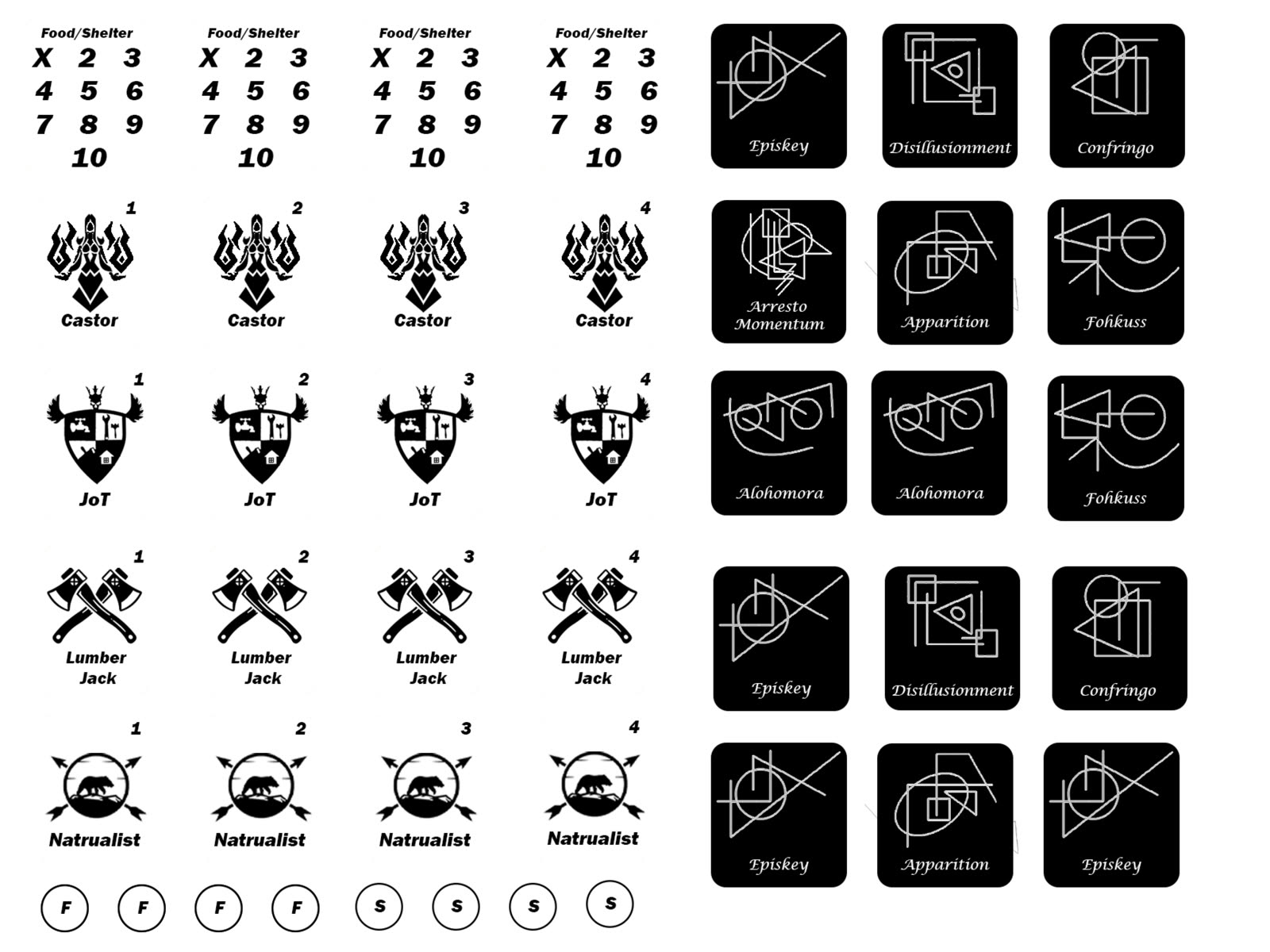
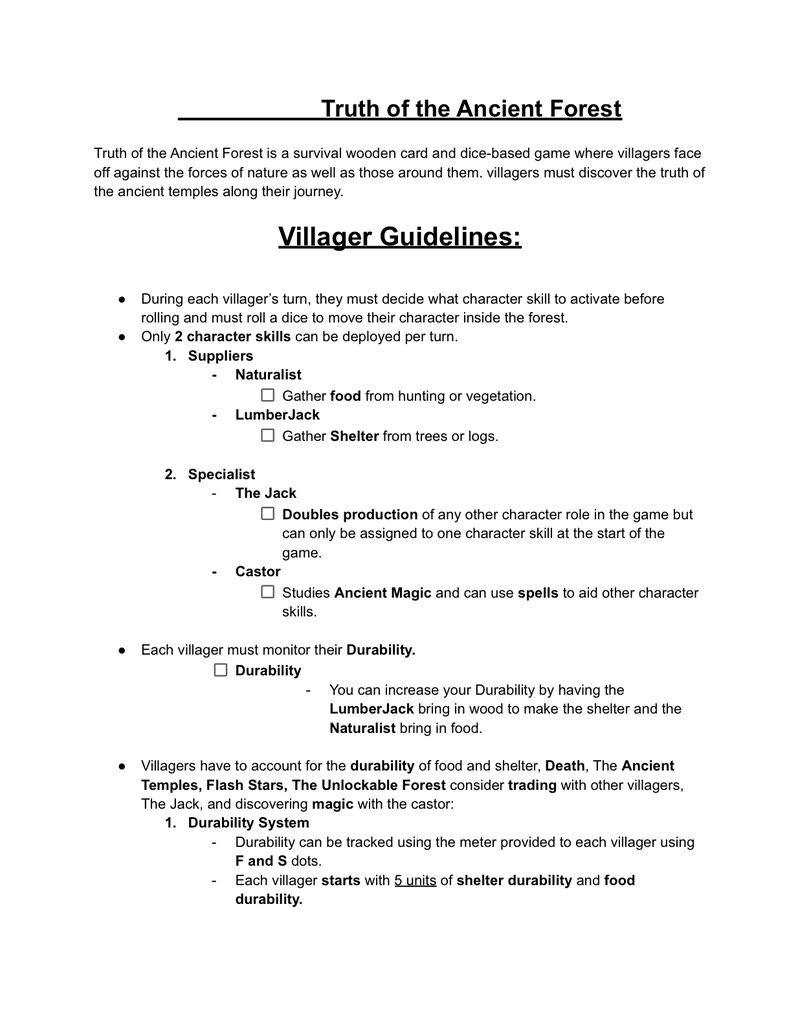
Four village leaders each command four workers — two suppliers who bring in food and shelter, and two specialists, one who doubles another worker’s output and one who studies magic. Every leader loses a unit of food a day, can only deploy two of their four workers a turn, and dies the moment either food or shelter runs out. Somewhere in the forest are ancient temples said to hold all the knowledge of the universe, and the first leader to open one wins.
The forest is not printed on a board. It is a pile of numbered tiles, and the map is laid down as people move into it — so the space every player is competing over is built by the players, in play, and is different every game.
The problem I set myself
The brief was rapid prototyping, so the real problem was not the game. It was finding out which of my ideas were any good fast enough to throw the rest away.
I did not know that at the start. I began with the ambition of a much larger game — villages that could attack each other, trade with each other, and live under a weather system that changed daily — and the four versions are mostly a record of that ambition being cut down to something that could actually be played.
Constraints
- A course timeline with versions due, not a finished game due. Every iteration had to be playable enough to test.
- A laser cutter and plywood. The final artefact is engraved wood, which means every mark on it is either cut or not cut. No colour, no gradients, no half-tones.
- Everything on the table has to be readable while four people argue over it.
- My own maker-space access. Version 4 was, by my own note at the time, four straight days of trying to get everything made.
What informed the design
- Betrayal at House on the Hill, credited in my own design document as the basis for the board — specifically the idea that a tile-laid map creates tension no printed board can, because nobody knows the shape of the space they are fighting over.
- Four rounds of building and playing it, which is the only research this project had and the only kind the brief was asking for.
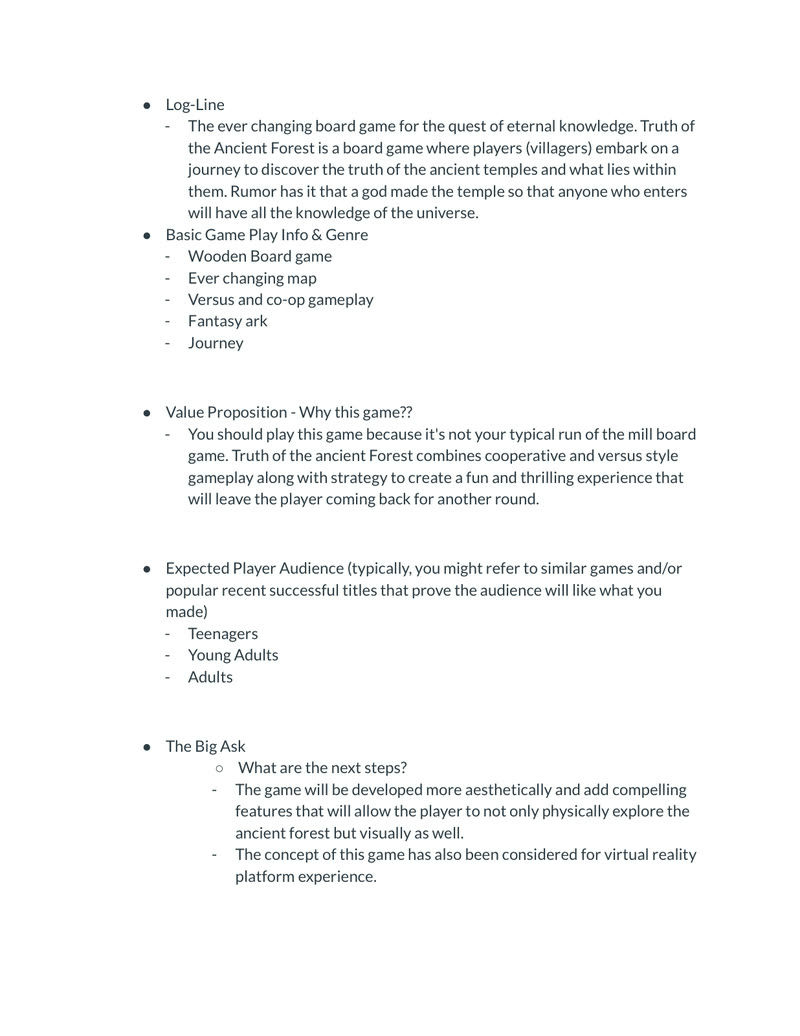
- A pitch written for a publisher, which forced me to answer why anyone would want this over a normal board game — and to write down, at nineteen, that the next step was a virtual-reality version of it.
What I cut, and why
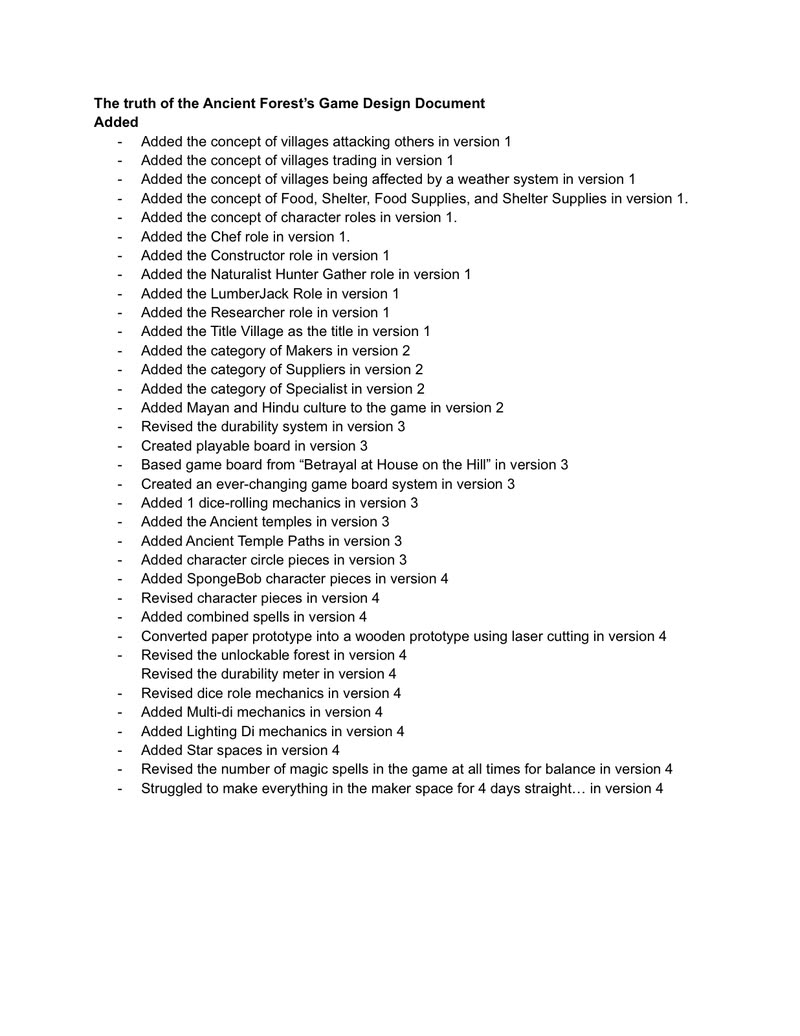
My design document is an explicit list of everything added and everything subtracted, version by version. Reading it back, the subtractions are the actual work.
The weather system. Fully specified and then removed in version 2 — two sunny cards, two rainy, one hurricane, two snowy, one snowstorm, one dry heat, each with its own penalty and its own rule about which worker it disabled. It was the most elaborate thing I designed and it made the game unplayable: every leader was resolving a private weather event before they could take a turn, and the table stopped moving. I cut the system I was proudest of because it was costing more time than it created interest.
Village versus village. Also cut in version 2. Direct attacks between players turned a survival game into an elimination game, and once a leader was behind there was no route back.
The game master. Removed in version 2. A game that needs someone to run it needs five people to play with four.
Half the roles. The Chef and the Constructor went in version 3, and the suppliers stopped ferrying food back to the village. Five roles sounded rich and played as bookkeeping; four roles with only two deployable per turn produced an actual decision every single turn.
Mayan and Hindu iconography. This is the cut I would most want a reader to notice. Versions 1 and 2 dressed the temples in real Mayan and Hindu religious imagery because it looked the way I wanted ancient and sacred to look. In version 3 I took it out, and in version 4 it was replaced with abstract geometric art made by Divine Siam. The spell names moved the same direction, from spiritual items to openly fictional ones. Borrowing two living religions as set dressing for a fantasy temple you loot for power is not a neutral aesthetic choice, and it was not mine to make. The abstract version is also simply better: it engraves cleanly, it reads at tile size, and it belongs to the game instead of to somebody else’s faith.
The paper prototype. Retired in version 4 when the whole thing was laser-cut into wood.
Key design decisions
The map is laid as you move. Roll into the known and you move; roll into the unknown and you place a tile there yourself, choosing from what you hold. Every player is building the board they are racing across, which means the map is a resource being contested rather than a surface being crossed.
Two workers a turn, out of four. The single decision that carries the game. Food drains every day whatever you do, so every turn is a choice about which necessity to neglect — and the Jack, who doubles one other worker but is assigned once at the start and never reassigned, makes that choice compound across the whole game.
Trades are made face down. A leader can request a trade, the other can refuse, and if they agree the cards change hands upside down and cannot be looked at until the next day. Trading with full information is arithmetic. Trading blind is a relationship.
Rolling a five or six forfeits your turn. Deliberately punishing, and the reason the forest feels like it is resisting you rather than waiting for you. It also means a good position can be lost to bad luck, which keeps a leading player honest.
The win condition is a burden to carry. The temple is opened by combining two spells, and the key spell is rare — and while you hold it you cannot gain food or shelter at all. Getting close to winning actively starves you. That is the best mechanic in the game and it came out of the version-4 rebalancing rather than the original design.
Black and white, because the laser only cuts or does not. All the art is line work on solid black or bare wood. The constraint of the machine set the visual language, and the abstract glyph style that replaced the religious imagery exists partly because it is what engraves legibly at the size of a playing token.
Outcome
A complete, playable wooden game, delivered as a course final in 2021: engraved role tokens for four players, durability meters, a deck of seven spell types with deliberately tuned scarcity, numbered floor tiles, and temple tiles. The pitch proposed a virtual-reality version as the next step, which is not nothing to read back five years later, given where the rest of this portfolio went.
What I’d change
Write down the playtests, not just the changes. My design document is a rigorous record of decisions and a complete blank on evidence. Four versions of what I altered, and not one line about who played it or what went wrong in front of me. I can defend every cut on reasoning and none of it on observation, and that is the habit this project should have taught me earlier than it did.
The spell names still are not mine. Having correctly removed real religious iconography, I replaced the spell names with ones lifted from Harry Potter. It solved the appropriation problem and created a trademark one, and for a prototype that is fine — but the version of this that goes anywhere needs its own vocabulary.
Kill the forfeit roll. Two faces of a six-sided die doing nothing is a third of all turns spent watching. The tension it creates is real and there are cheaper ways to buy it — a partial move, a cost, a choice between bad options — that do not take a player’s turn away entirely.
Documents
Next
 Case study
 Recollection
A wedding recorded from every direction, so nobody is stuck with one person’s edit of it.
Inhabiting Memory
A family museum you enter on foot — built from interviews, tested against flat photographs.
 Case study
 Spark
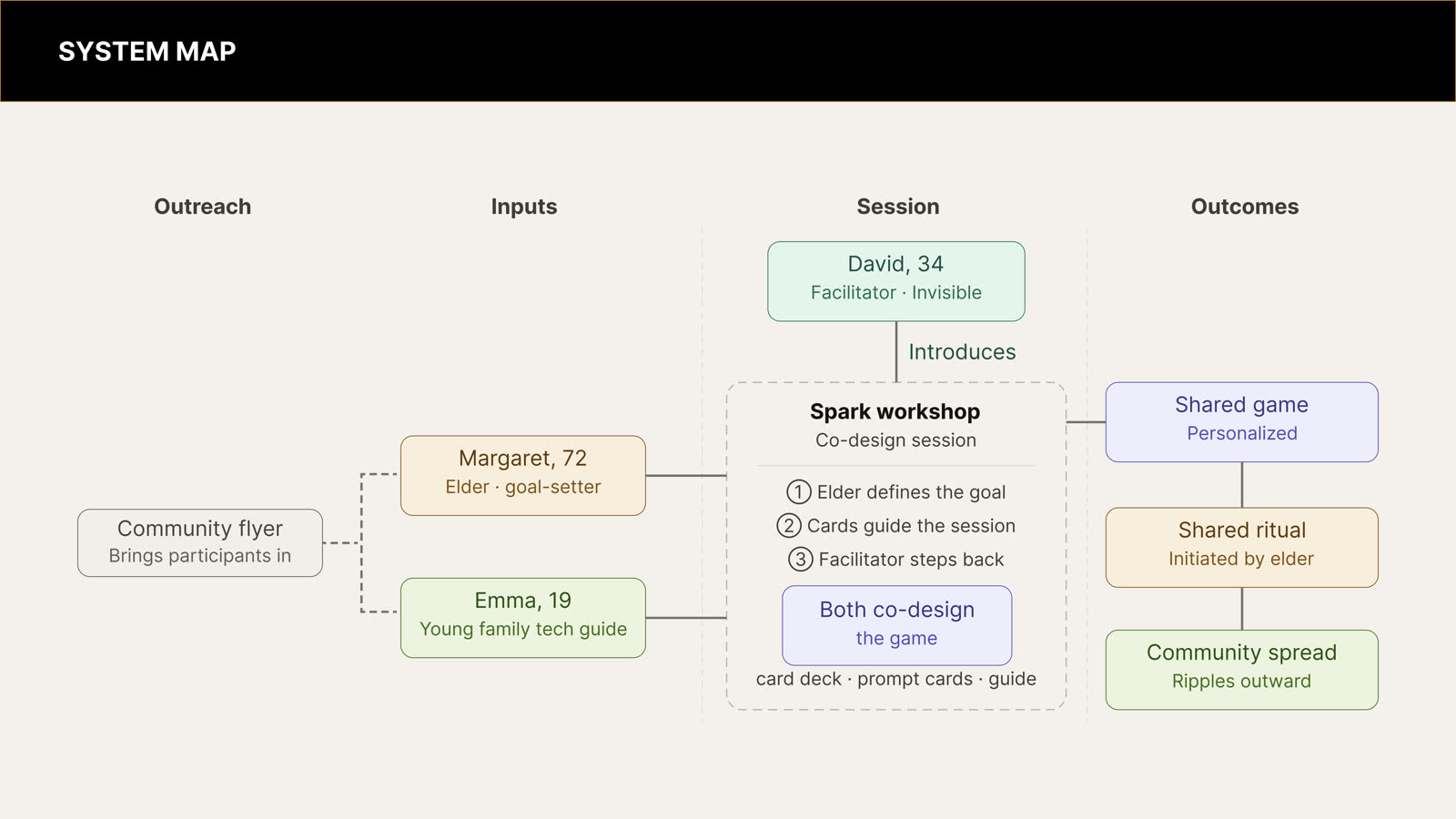
A card game an older adult designs the rules for, and their grandchild has to follow.
Buddy Run
A running coach that guides by rhythm instead of telling you to speed up.